









Current State of Household Robotics
Robots have been used in the manufacturing industry for decades, performing such mundane tasks as painting automobiles and assembling machines. The new developments in robotics technology have greatly increased the efficiency of manufacturing by as much as 20 percent in the automobile manufacturing industries [1]. In more recent times, there have also been great advancements in military as well as search and rescue robots. Despite some progress, development in household robots is slow in coming, with little products reaching the consumer market [2].
Today, most of the consumer robots are purely for entertainment purposes, such as Aibo by the Sony Corporation and Robosapien by Wow Wee International. Robots that can perform everyday household tasks, such as cleaning, have a very small market and their functions are limited. Roomba, developed by iRobot, is one of the few household robots that has gained popularity in the consumer market. Its ease of use and relative low price has allowed it to enter into people’s houses. In fact, one million Roombas were sold by the end of 2004. Roomba's capabilities, however, are still limited. While great on a simple floor layout, Roomba can get stuck if the room in arranged in an odd manner or if the floor is occupied by many critters. Also, Roomba will usually do a poor job on thick, furry, and heavy carpets [3]. Moreover, the computer algorithm responsible for guiding the movement of the Roomba is not very efficient as it often re-vacuums an area of floor several times, thus wasting both time and battery life [4]. This, however, should not be a surprise as the Roomba has less than 40 MIPS (Millions of instructions per second) of processing power [5], which is less than that of an insect [6]. Its low processing power renders it inefficient in navigating around complex room layouts.
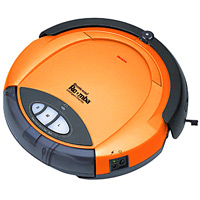
Roomba [14]
Most of today’s household cleaning robots use a random algorithm to navigate their way around the room. The concept behind this algorithm is that with enough time the random movements of the robot will allow it to sweep or vacuum every spot in the room. This random method, however, usually takes a long time to cover all areas because the algorithm does not know whether it has cleaned an area or not. As some owners of Roomba indicated, it is often frustrating to have the robot vacuum for them because it takes too long [4]. The main reason for this relatively primitive algorithm is that the processing powers of most household robots are fairly limited. Most of today’s household robots have microcontrollers that operate at less than 50 MIPS, therefore practically incapable of intelligent navigation [6]. Today's industry has the technology to produce processors that are more able to control the navigation of cleaning robots, but it is unprofitable to place these processors into robots for retail sale. Also, most of the contemporary household cleaning robots lack sophisticated visual sensors, hence they are not able to detect obstacles and map out a room efficiently. These two short-comings severely limit household cleaning robots to function as insects in the dark, feeling their way around the house with no way to track their travel.
All of the cleaning robots on the market move around by simple wheel systems. These systems are easy to construct and are very inexpensive to produce, thus reducing the overall cost of production. While great for flat areas, these robots cannot climb stairs or run over obstacles [2]. These limitations restrict where the robots can go and often require human supervision and assistance. There is, however, equipment available to prevent these robots from going where it is not suppose to, such as the Virtual Wall for Roomba [8].
In lieu of these deficiencies, the current household cleaning robots can only be considered pre-first generation machines [6]. They focus on a specific aspect of household cleaning and can only perform chores for which they are built. They are incapable of performing intelligent behaviors and have simple sensory devices to detect and map its environment. Yet, these robots represent a significant improvement over their traditional non-robot counterparts as they relieve people from performing mundane household chores.
