|
Current State
Ours is an age of widespread technological revolution. Advancements in robotics are rapidly altering the configuration of modern society. The need for manual labor is diminishing as machines are developed that are capable of performing the menial tasks once required human labor. Correspondingly, now intellectual cultivation is the catalyst driving progress.
Household dynamics, too, are evolving to accommodate new technology. Robots capable of completing domestic chores enable the individuals whom own them to spend their time more valuably. Instead of wasting time completing tedious tasks, people can have more leisure time that they may use to pursue intellectual interests. Additionally, individuals with physical limitations that render them incapable of doing strenuous chores may still maintain their homes and yards with a greater degree of autonomy.
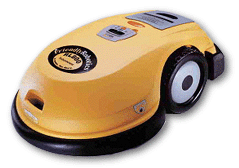 The most lucrative prospects for advancement are those which apply to the most arduous and time-consuming tasks. Accordingly, the robotic lawn mower currently available offers many opportunities to benefit society as well as the individual. However, these opportunities are just that- valuable, original, and unrealized prospects. The existing models have several operational, economical, and mechanical flaws that make the devices impractical for large-scale distribution. The most lucrative prospects for advancement are those which apply to the most arduous and time-consuming tasks. Accordingly, the robotic lawn mower currently available offers many opportunities to benefit society as well as the individual. However, these opportunities are just that- valuable, original, and unrealized prospects. The existing models have several operational, economical, and mechanical flaws that make the devices impractical for large-scale distribution.
Obviously, the potential benefits may only be realized if the robotic lawn mower is made both technologically sound and widely available. The current model may be viewed as a pioneer. Many features, such as the mulching device that eliminates clippings while simultaneously aerating the lawn, and the docking station that allows the mower to be programmed to operate at a specific time without assistance, are in fact very revolutionary.
However, several remaining basic operational flaws render the mower largely impractical. For example, the robotic lawn mower often has difficulty maintaining an accurate course and retaining sufficient power. Additionally, environmental challenges severely restrict the robot’s useful applications. The mower is virtually inept at cutting variable lengths of grass, avoiding obstacles, and maintaining control on uneven terrain. And at a cost of nearly $499, only the most affluent consumers can afford to purchase the mower. Any mechanical improvements must be reconciled with rising cost.
The objective is to make the product available to the masses without compromising its technological integrity.
|
|
