O.C.A.P. (Older Citizen Assisting Protocol) SpecificationsA solution to the 'growing' problem of taking care of the elderly has come in the form of the O.C.A.P. (Older Citizen Assisting Protocol). Designed to take care of difficult tasks, the O.C.A.P. can act as a caretaker for anyone. 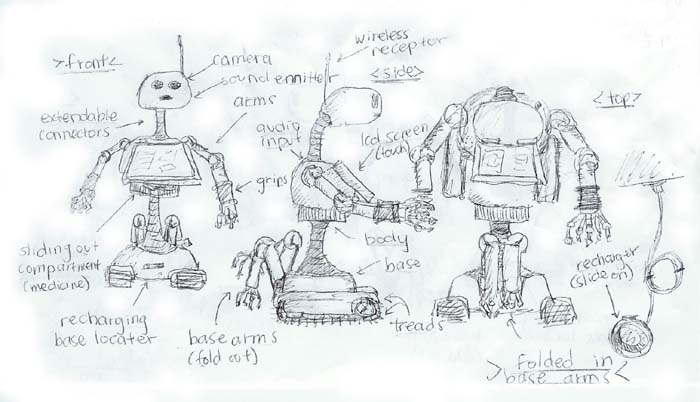 The O.C.A.P. is humanoid in shape, with robotic arms that fold out of the base and chest of the robot. These arms have carefully placed light sensors and touch sensors that can easily distinguish the traits of different materials, classifying them, for instance, as fragile or heavy. The fingers can extend, allowing O.C.A.P to grasp a wide range of differently shaped objects. With a built in camera, sensing the edges of objects by color recognition, a feature used frequently in the motion picture industry for digital grading and masking, can be put to effect to help make O.C.A.P.'s differentiations. To accommodate a senior's walking problems, its lightweight titanium chassis and extended arms offer a strong, sturdy, and graspable support. Designed to be adjustable, the upper arms of the robot act as the grip, leaving space between the senior and the base of the robot to accomodate walking. The O.C.A.P. can strike up a conversation, understanding literally hundreds of thousands of words, strings of words, tones, and expressions. Adept in multiple languages, this robot can crack a joke, discuss the latest events, and brighten a lonely senior's day. This robot has a simple, innovative touch-screen, with a large display in order to help those seniors with dimming vision. In addition to this, O.C.A.P. can understand voice commands, giving seniors a wider range of options when communicating with their metal friend. With several simple games accessible through its monitor, it can keep the senior entertained with checkers, chess, and other board games. O.C.A.P. has battery charge awareness, allowing it to use its unique recharger-paging device and echolocating path-finder, used to avoid walls and other obstacles, to locate its charger and attach itself to it, recharging its expired cells. To monitor health, O.C.A.P. can follow a senior's medication schedule, allowing it to give reminders and make available the required dose of medicine via a small compartment in its chest. With audio and video recognition, it can track changes in posture and normal actions, and monitor coughing and other signs of illness, notifying family or doctors with a phone call. Designed to distinguish coughs from speech or other sounds, O.C.A.P. can track if the client coughs more than normal, indicating that something is wrong. A huge portion of the price depends on the cost of developing the technology - the AI, data retention, and mechanics. Assuming O.C.A.P. be built now with our current technologies, a project like this would be extremely costly on both the client and the developer's part. A rundown of costs would look like this:
This could potentially make O.C.A.P. a reasonably priced robot, if the technologies are readily available. |
Research Site
Current Technology
Current Problems
Requirements
Proposal
Bibiliography