Current State of Care-Giving RoboticsWakamaru 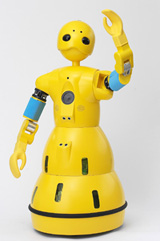 One of the most famous bots in Japan designed to assist the elderly is a bot called Wakamaru, developed by Mitsubishi Heavy Industries of Japan. Wakamaru can remind patients to take their medicine, phone a doctor or emergency dispatchers when the patient appears to be in trouble, and has voice recognition capabilities as well as a built-in dictionary to converse with people. [6] The robot can also talk to the patient and initiate conversations via a record it keeps of their daily life patterns, as well as access the Internet for them and provide security by monitoring the home while the patient is away. These are merely some of the capabilities that Wakamaru has; since it keeps track of daily life patterns, if the patient deviates from these patterns widely it can alert others. [7] The intent of Wakamaru is for the bot to be with patients as a sort of replacement nurse and as a companion; however, the bot is not designed to completely replace human companionship. While Wakamaru is arguably the most well known robot designed for taking care of the elderly, several factors prohibit it from being popular in mainstream society, American or Japanese. One is its prohibitive cost: its current price is about 1 million yen, or roughly US $14,250. Although this is less than hiring a healthcare worker full-time, societal concerns also influence buyers. In the US, the bot may not be accepted in a standard household; according to one theory, in the US people are used to thinking of robots as sterile machines that might replace their jobs, while in Japan robots are thought of more as being like companions. [8] The bot may therefore not be accepted overseas. The idea of Wakamaru is interesting, since it reminds elderly people about medicine and other necessities in a non-intrusive way and is designed to be cheerful, friendly, and communicative. Paro  There are also robots designed to provide companionship to elderly people, such as Paro. Paro was developed by Japan's National Institute of Advanced Industrial Science and Technology. It was used in a famous study by Takenori Shibata in Japan of the use of robots in therapy. Paro is a robot shaped like a seal, built to give therapy and companionship to the elderly. It's designed to be cute and cuddly; sensors in its fur and whiskers allow the seal to respond to petting by purring and arching its back. Pet therapy, where people with various handicaps are treated by interacting with a pet, has been proven to help people physically, psychologically, and socially, as well as to reduce their stress levels. [9] Some elderly people are unable to own actual pets because of allergies or other reasons such as pets not being allowed in an apartment (for example), and a robot pet might be perfect for them. [10] However, there is a danger that elderly may become too attached to their robot pets if it became necessary to give them up, or that robot pets might replace real pets and human interaction. This is unlikely because most elderly, at least in a study in Japan, recognize the difference between robots and humans, and say that they would not give up human companionship. [11] Pearl  Researchers at Carnegie Mellon University developed a robot that can serve as an assistant for nurses in retirement homes and hospitals. This four foot tall robot has components that are together worth $100,000. Despite this, it is not very advanced yet. Programmers are working on enhancing its features and increasing its versatility.  Pearl is very close to what we picture in our minds as a robot. It has a collection of wires and chips, a humanoid face that can blink its eyes, and a computerized female voice that can ask questions like "Have you taken your medicine?" One of the main features of Pearl is its guidance system. Equipped with sonar detectors, a laser range finder, and mapping software, it can avoid obstacles and guide those with memory problems. There is a touch-screen that displays a map and an arrow that points out the necessary route. The screen can also display reminders and advice and allow the user to make requests. On the side of Pearl are side-rails for the elderly to hang on to while the robot travels. The robot moves at a maximum of 50 centimeters per second, which is relatively slow pace appropriate for seniors. Pearl's guidance capabilities allow nurses to concentrate on other tasks instead of assisting seniors to walk to dinner or something similar. However, it should be noted that the goal is not to replace humans as companions, but to provide assistance for the older generation. Human touch and interaction are important to the elderly and are something artificial intelligence can never provide. Researchers are planning to upgrade Pearl so that it can monitor pulse, blood pressure, and other vital signs, help seniors pick up or move objects, and memorize a daily routine. [12] Snuggling Ifbot  The Snuggling Ifbot is an excellent companion for the lonely elderly. Although it is only 45 centimeters tall, it has intelligence equivalent to that of a five-year-old. Millions of world-phrase patterns along with speech recognition were programmed into it so that the robot could engage in conversations with the user. This is especially important to the elderly, because it encourages mental activity and prevents them from becoming forgetful. In addition, the Snuggling Ifbot is capable of performing calculations, playing puzzle and memory games, singing songs, reading news aloud, and inquiring about health. In the future, additional devices will be installed so that it can contact local medical personnel in case of emergency. Currently, the Snuggling Ifbot can only communicate in Japanese. Developers are planning to program the robot in English for the purpose of teaching Japanese children English. [13] |
Research Site
Current Technology
Current Problems
Requirements
Proposal
Bibiliography