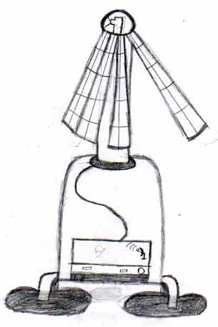
Our rover system will use solar as the main source of power. A solar collector unit (see diagram below) will be placed in an area that has 90% sunlight permanence. This area is on one of the rims of the de Gerlache crater. Both Clementine and LRS has documented the existence of this permanently sunlit area. [18]
The lunar night can be 300+ hours long in some places. At the South Pole the sun doesn’t rise high but does remain visible from several places. The problem is that because of the the low rise, mountains and hills block the sun in many places. This means some periods of darkness and lack of solar power. To solve this problem a closed loop regenerative fuel cell will be used to store electricity for times during darkness or travel into the basin area of permanently shadowed spaces.
A regenerative fuel cell is the reverse of a hydrogen fuel cell. The hydrogen cell takes hydrogen from a storage tank and oxygen from the outside air, combines them and produces electricity. The by products are water and heat. The regenerative fuel cell uses electricity to make hydrogen and oxygen from water and then puts them back in to make more electricity. The system is closed and has no by products. The water, hydrogen and oxygen are used over and over. How does this work on the moon? You start with a tank of water and use electricity from a solar panel to divide the water into hydrogen and oxygen. The hydrogen and oxygen are used to create the electricity during the lunar dark periods. The system should just continue to work without needing to be refueled. Six times more energy can be stored over rechargeable batteries of the same weight. The system will be insulated and enclosed to make it rugged for lunar environment. Glenn David Bents is working for NASA developing the regenerative fuel cell for lunar exploration. [10]
The rover will also have solar panels that will be used to supplement the batteries. Power from these will generate up to 140 W of power under the full sun conditions. There will be two rechargeable batteries to store this power. This will allow the robot to travel farther away from the fuel cell and stay away for longer times. These will not be able to be used when the robot goes into the permanently shadowed areas. It will depend upon its charged batteries during these missions.