Mars is another popular target for future human colonization. The famous Mars Exploration Rovers Spirit and Opportunity have, since landing on Mars roughly two years ago, have searched for evidence of water and environments conducive to life on Mars and collected much data about Mars' geology on the way. Spirit has thus far found evidence of chemicals that came from water (6). The rovers use instruments such as the Miniature Thermal Emission Spectrometer, which identifies minerals by the thermal radiation that they give off, to analyze the chemical composition of Martian soil and look for evidence of water (7). As for finding water on the moon, Aitken Basin is the likeliest site for water. Aitken Basin is deep enough, and its sides steep enough, so that some parts of it are always shadowed (8). This fact is part of the reason why it's likely that there will be water in Aitken Basin; water is unlikely to melt due to solar heat in regions that are constantly in shadow (9).
Although the purposes of the MER robots and of a lunar robot that would be sent to search for water are similar, some fundamental differences in the Martian and lunar environments prevent MER technology from being used for lunar robots. 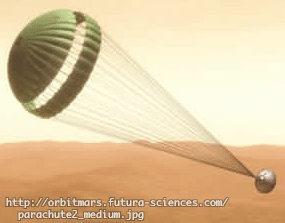 First is that parachutes, along with rockets that slowed the rover down, were used to control the robot's descent onto Mars. Parachutes require air or something to provide a resisting force in order to work the way they are intended to. Parachutes may be used on Mars because, although its atmosphere is relatively thin, it does have an atmosphere. The Moon's atmosphere, on the other hand, is almost negligible. The Moon, having a relatively small mass, doesn't have enough gravity to keep gases from escaping into space. Lunar robots would need to rely on rockets to slow them down so that they could land safely on the Moon (10). Communications will also be a problem; the MER robots can communicate both with satellites orbiting Mars that transmit data back to Earth and directly with Earth (11). Any robots in Aitken Basin, which is on the Moon's far side (12), will be unable to communicate with Earth directly; they will have to rely on transmitting data to a satellite which will then transmit data to Earth. As the robot is unable to communicate with Earth directly, instructions will either have to be given to the robot via the satellite, the robot will simply have to have very good programs that would allow it to be autonomous, or some combination of the two. A satellite placed at a Lagrangian point on the far side of the moon, where it would remain stable relative to the Earth and Moon in space, would be ideal for such communications (2). The problems of braking and of communication are the two primary problems that would prevent a MER robot from being used for a lunar mission.
Additionally, the design of the robot that we would send to the Moon's Aiken Basin and the MER robots differ in several fundamental ways. The MER robots use solar panels to collect energy, which they store in rechargeable batteries so that they are able to move around at night and in case they need extra energy 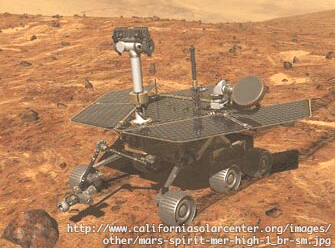 (13). Aitken Basin is the deepest crater on the Moon (14), and thus some parts of it are constantly in shadow (15), which obviously means that the rovers will be unable to rely on solar energy while there. One possible idea to provide the lunar robot with energy, discussed in the design for the lunar robot section, is to set up solar panels outside the crater that would collect solar energy and store them in power stations, which would then transfer energy to the robot. Another difference in design between the lunar robot and the MER robots that might arise is that because the Moon has no atmosphere, lunar rovers would be more susceptible to radiation and being damaged by random space debris (16). Thus, lunar rovers would need extra protection against these things. Lastly, the Moon's surface temperature fluctuates wildly due to its lack of an atmosphere, which makes it unable to trap heat (5). It varies anywhere from -153 degrees Celsius during the night to 107 degrees Celsius during the day (17). Temperatures on Mars fluctuate from -99 degrees Celsius to 22 degrees Celsius, a much smaller temperature range; the MER robots must nevertheless keep their temperature within a certain narrow range in order to ensure that all the equipment keeps working and doesn't freeze or overheat (18). However, the parts of Aitken Basin that are in shadow will have a relatively constant temperature of around -220 degrees Celsius (19); thus, lunar robots in Aitken Basin will need constant heating, and much more heating than a MER robot, in order to continue operating and searching for water in the shadowed areas.
The MER robots and our lunar robot differ in significant ways; however, they also have many features in common. The two types of robots have similar purposes and thus would carry similar equipment for analyzing the composition of the given body's soil, such as drills and spectrometers. Both types of robots would need sophisticated imaging software and navigational software to aid in their search for water as they navigate the terrain. However, fundamental differences in the environments of the Moon and Mars prevent us from just reusing the MER robots for a lunar mission to search for water.