One of the major goals of humankind has been to set up bases on the Moon and other extraterrestrial bodies. Water, being necessary to human operation, is a vital component of any environment that humans might set up permanent residence in. Humans need water not only
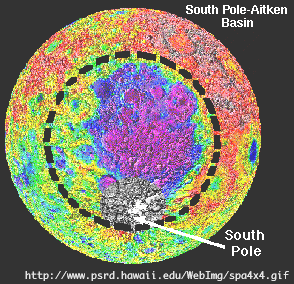 for consumption, but also for the manufacture of oxygen and hydrogen fuel through electrolysis. Therefore, humans must look for water on the Moon if they wish to establish any sort of outpost there. Robots such as the lunar robot specified later in this report are necessary to map out sites that have water and other items necessary for human life. Aitken Basin, due to the fact that some areas of the basin are in permanent shadow, is a likely spot to look for water on the Moon. After all, if no solar heat reaches an area, water will not melt and evaporate (3). Areas in permanent shadow are thus the most likely spots to find water on the Moon. The disadvantage of working in permanent shadow on the Moon is that the temperature is constantly very cold, near absolute zero (1). Thus, robots looking for water in such an area would need quite a bit of heating to remain functional; this idea will be further expanded on in the MER robots vs. lunar robots section.
In general, the Moon has a very harsh environment, inhospitable to human or most other organic life. Temperatures at the surface fluctuate between -153 degrees Celsius during the night to 107 degrees Celsius during the day (4). The Moon, having relatively little mass and thus lacking the gravity to hold gas and make an atmosphere, is unable to hold heat from the sun. Planets with atmospheres, such as Earth, are more conducive to life because the solar heat trapped in the atmosphere allows for a fairly narrow temperature range (5).
Aitken Basin, while being an ideal environment to search for water in, is not terribly conducive to human life, with freezing temperatures and little to no atmosphere. However, searching there for water is a good start for looking for ways to make the Moon more hospitable.