


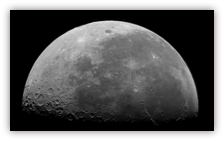
Ever since man stepped on the moon back in 1969, scientists have dreamed of establishing a lunar colony. Many believe that this is the first step to exploring the universe. Discovering water on the moon would give future astronauts the ability to ‘live off the land’ (in-situ resource utilization) and set up a permanent settlement. The ice on the moon could be mined and separated into its elements, hydrogen and oxygen, using electricity from solar panels. The hydrogen and oxygen could make a rocket fuel and provide water and air for a moon colony.
Mars By Way of the Moon - Why?
Scientists believe the moon provides a perfect near-by place to practice before colonists try to go to Mars. The moon and Mars are similar in that they are both cold, have less atmosphere than the earth, and lower gravity.
Moon Mars
Earth gravity 1/6 1/3
Atmosphere none thin
Low Temperature -240˚ C -100˚ C
Surface dust Regolith up to 10 meters deep
Frozen water Polar Region Poles to Equator
New technology is being developed to control the dust problem interfering with the machinery, detect and mine the permafrost, separate ice into hydrogen and oxygen for supplies, and build habitats on the ice rich soils that won’t collapse under weight, It will be much easier to test all of this technology on the moon which is only 2 to 3 days away from the Earth rather than on Mars which takes 6 months to reach.

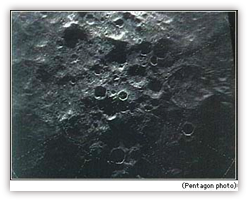
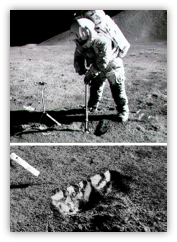
Regolith is the silt fine dust covering both the moon and Mars. Micrometeorites, cosmic rays and solar wind particles caused the moon’s regolith and on Mars impacts of massive meteorites and daily erosion from water and wind was the cause.



