





The Big Hole...
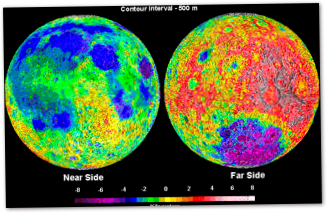
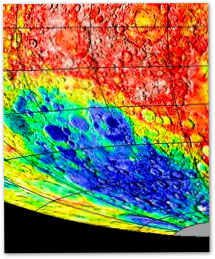
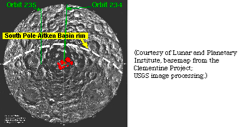
In the middle of the 1960’s the Lunar Orbiter Program proved that the South Pole Aiken (SPA) Basin really existed, but it wasn’t until the 1990’s that scientists began to understand the size and depth of the basin. It is the largest impact crater in the Solar System at 2500 km in diameter and over 13 km deep. It covers the entire south pole of the Moon and is centered at 50 ˚ south latitude.
WHERE DID THE WATER COME FROM?
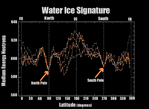
Meteorites and comets hit the moon’s surface all the time. Most of them contain some water ice that would be scattered over the surface. The intense sunlight would split the water into atoms of hydrogen and oxygen and most of these would go off into s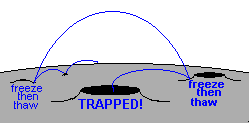 pace. But some of the atoms would hop from place to place until they collected in a very cold region without sunlight. They would freeze there and be covered by meteorites. In 1998, NASA sent Lunar Prospector to check and see if there is ice on the moon. The spacecraft used a device called a neutron spectrometer. Lunar Prospector scanned the moon’s surface for hydrogen rich minerals. The neutron ratios indicated hydrogen. Many researchers think it it the H in H20, hence water.
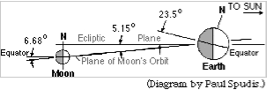
pace. But some of the atoms would hop from place to place until they collected in a very cold region without sunlight. They would freeze there and be covered by meteorites. In 1998, NASA sent Lunar Prospector to check and see if there is ice on the moon. The spacecraft used a device called a neutron spectrometer. Lunar Prospector scanned the moon’s surface for hydrogen rich minerals. The neutron ratios indicated hydrogen. Many researchers think it it the H in H20, hence water. On the Moon the Sun is always close to the horizon at the poles because the plane of the moon’s orbit around Earth is 5˚ and its equator is inclined at 6.5˚. This means the tilt is only 1.5˚ on the Moon’s spin to its orbital axis. There are places deep in craters on the south pole that never see the sun and the temperature is never above 100 K (280˚ below zero F.
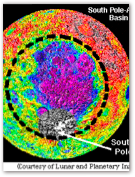

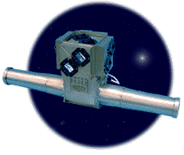
Neutron Spectrometer
Cosmic rays hit atoms in the soil and release neutrons. The neutrons scatter and hit other atoms. The spectrometer measures the neutrons. Neutron detectors see concentrations of hydrogen in about the first meter of the surface.