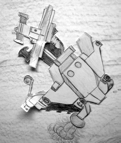



Moon Aqua Retrieval Crater Investigation
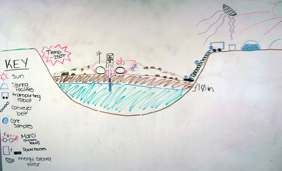
MARCI is a rover that will be sent to the moon to harvest ice. The best location is the South Pole Aiken Basin. The constant -230 ˚ temperatures are cold enough to trap the molecules of water. Because of the low Sun rise over the poles, there is an area of over 15,000 square kilometers of permanent shadow. Scientists will study the lunar surface there to find craters that will be good mining sites. Space telescopes like the Hubble will be used to take sharp clear pictures and spacecraft like Clementine will search for markers of water using radio waves and instruments like the neutron spectrometer. A good place to land would be the area called the ‘peak of eternal light’. This is a ridge between several craters. The sun shines here almost all the time. A power station could be set up here to charge batteries for robots and machinery. MARCI will land near the edge of a large crater such as the Shackleton or de Gerlache. Large craters with small craters near by that are newer and have less steep sides are the best choice. MARCI will look for ice using the neutron spectrometer. It is believed that the ice will be found around 10 inches under ground.
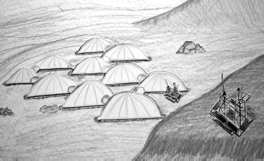
MARCI will set up a whole work area for herself. First she will land and set up a power supply up on flat ground and will also deploy portable houses that will be used to store all of the core samples. The portable structures will be brought down on a lander from orbit and placed as close to the mining site while still able to receive communications from an orbiting geostationary mirror satellite. Once that is done the power house will immediately begin harvesting solar rays from a giant mirror that is orbiting the moon in a stationary position. The mirror satellite will automatically position itself for maximum refection of sunlight to the surface. This will provide power to places that do not have sunshine. The small transport rovers can carry charged batteries from the power station and the solar center at the mirror site.
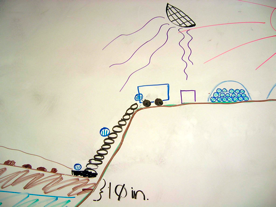
MARCI will then deploy a little robot right before she enters the crater, then she will continue her way into the great basin. She will find an area that is flat enough to where she can sit without being uneven. The wheel lock will come out to ensure that the rover is completely stable. Before this the smaller robot that is sitting at the top of the basin will let out a conveyer belt (similar to dropping a rope ladder) and a small box (this is a power supply that is connected to the other box on top of the crater). The box will be cushioned to land softly at the bottom on the crater side. MARCI will secure the end of the conveyer belt and the power supply box. The power supply is replenished from the solar panels at the top of the crater through cables.
MARCI will then begin taking the core samples. She will retrieve three every one trip. Once they are all secure on the back part of the rover she will drive over to the conveyer belt and gently dump them, so they can can travel up and to the little robot. When MARCI is doing this she will be plugged into a socket on the little power supply. This way she is charging and will have enough energy to go back out to the crater. Once the core samples reach the top of the conveyer belt they will fall into the little robot. Then that little robot will drive the three core samples over to the portable houses for storing. After this the process starts all over again.
The robots have the option to move in many different ways. We believe that the most efficient way to get around is using tracks. The tracks are made of a strong rubber, just like the rubber they use in fireman boots. the tracks can also have spikes on them and under the spikes there are hooks that can hook into the ground. They would also have molded tires. So if it moves it digs into the lunar surface and gets around a little faster.

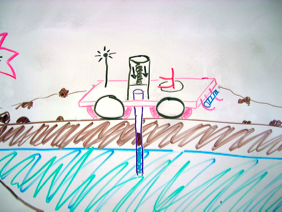

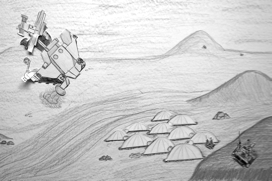
MARCI showing the core removal device
The Portable domes will house the supplies and later be used for human colonists.
The Lander brings the domes and other supplies down from an orbiting space station.
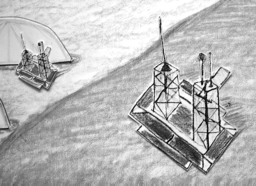
Communications towers will be set up to relay information and commands to MARCI.
The Lander